Introduction
The seroprevalence of Toxoplasma gondii infection in the human population in Europe ranges from 18% to 50%, depending on the country (1), and it is expected that half of the population will seroconvert by the age of 46, although the intensity of infection varies significantly among geographic areas (2). The differences between countries are due to factors related to culinary habits and socio-demographic development (levels of hygiene and awareness of preventive measures) along with environmental factors linked to the frequency of contamination by T. gondii oocysts and their survival in the environment, and thus exposure to the various environmental matrices that constitute potential sources of infection for susceptible intermediate hosts (3). Several review studies suggest a decline of the level of seroprevalence and the incidence of congenital toxoplasmosis in the European countries (1,4), a fact that might be related to changes in exposure in recent years.
Globally, acquired toxoplasmosis is ranked second by incidence among 14 major parasitic diseases and accounts for a remarkable figure of 825,000 disability- adjusted life-years (DALYs) in 2021 (5). Furthermore, the European Food Safety Authority identifies T. gondii as one of the three most significant foodborne parasites in Europe; however, there is no routine monitoring in the food and water industries (6).
The meat-borne infection route results from the contamination of meat and meat products with tissue cysts of the parasite, which contain numerous bradyzoites and constitute the quiescent form of the infection (7). On the other hand, the environmental route is associated with contamination of water bodies, soil, fresh products and bivalves by sporulated oocysts of the parasite, which are highly resistant to environmental conditions. The role of felines, and primarily domestic cats (especially feral and stray cats), is key; members of the Felidae family are the only ones capable of supporting the parasite’s enteroepithelial sexual cycle after ingestion of preys bearing tissue cysts and, due to their prevalence/frequency, play a fundamental role in the dissemination of the pathogen, as a cat with a primary infection can shed millions of oocysts in its feces over a short period of time (7).
Historically, meat and meat products have been considered the primary sources of T. gondii infection in humans (3); however, exposition to environmental matrices appears to be more significant than anticipated, as numerous recent studies reported considerable levels of contamination with T. gondii oocysts (8). Indeed, recent studies aiming to identify risk factors of infection demonstrated that anti-T. gondii seroprevalence levels in humans were not statistically different in vegetarians compared to people who include meat in their diet (9).
This article aims, by posing two questions: i) What are the predominant sources of infection? and ii) To what extent do meat-based and environmental routes contribute to human infections? to shed light on potential foodborne risks associated with alternatives to the consumption of meat and meat products and to demonstrate the need to conduct well-designed studies to assess the risk posed by such products to humans.
Exposure to the parasite: modes of infection and source attribution
At present, the exact proportions to which meat-borne and environmental routes contribute to human infections are unknown (10). Although not representing the contribution of T. gondii sources to all human infections, a systematic analysis of toxoplasmosis outbreaks globally (11-15) indicates that the main known or suspected sources are meat (43% of cases), water (26%), soil/dirt/sand (18%), and fruits and vegetables (5%); other sources, such as milk, account for 6%, and the source is unknown in 2% of episodes (Figure 1). Only three toxoplasmosis outbreaks have been described in Europe, two were associated with the ingestion of undercooked meat in Ireland and England and the other was caused by consumption of unpasteurized goat milk in Scotland (11).
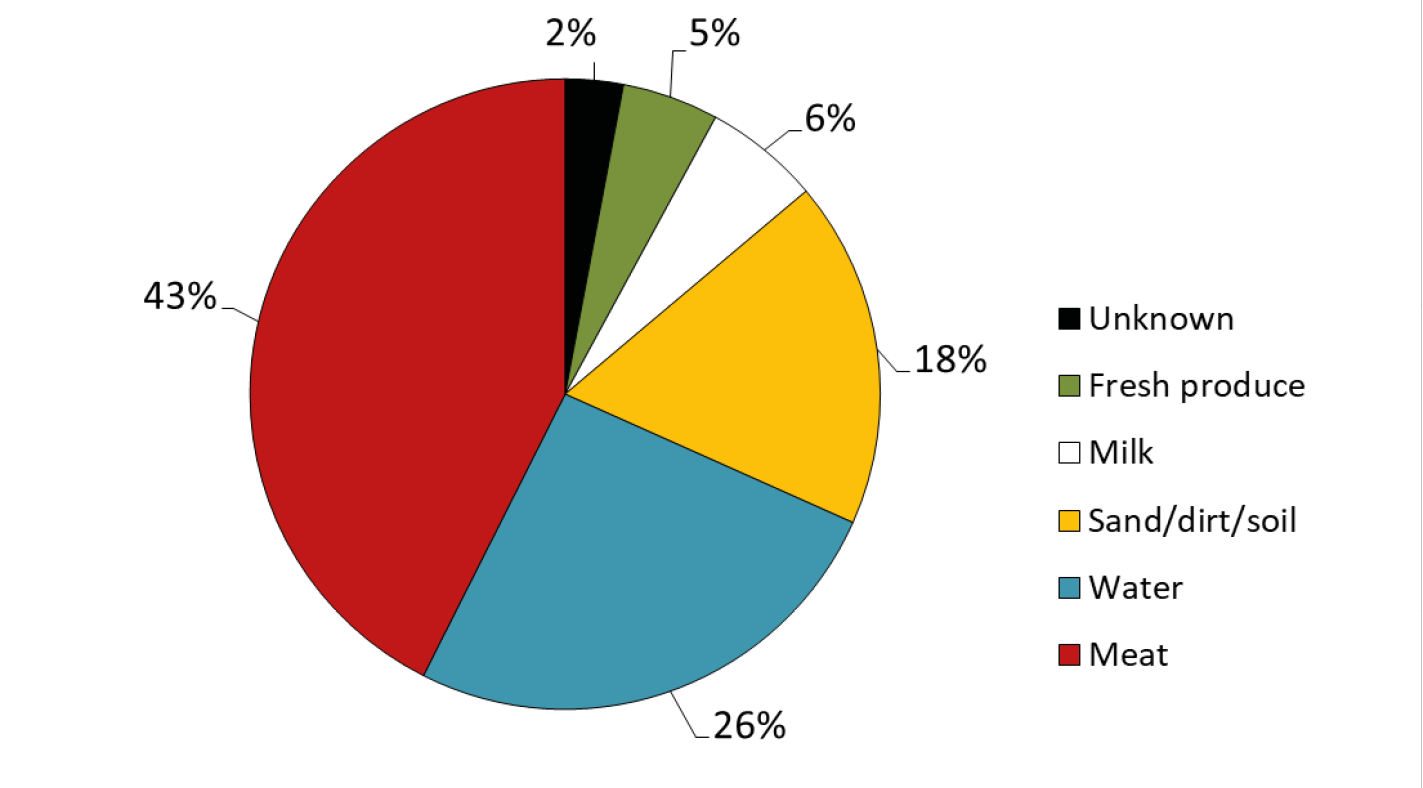
Compilation of data reported in several studies (11-15) identified that the number of confirmed cases (min. - max.) vary per source of infection: milk: 2 – 10, meat: 1 – 105, vegetables: 11 – 74, soil/dirt/sand: 1 – 171, and water: 9 – 931; in this sense, water-driven outbreaks are those causing higher number of cases of illness due to exposition of a remarkable number of people to the same source (e.g., water from contaminated wells), and others related to meat ingestion are mostly circumscribed to families or social events encompassing a lower number of affected people (14, 15).
The environmental route has been less frequently studied than the meat route (3 , 16). In this regard, 30–60% of infections could be attributed to meat as the infection source, while 6–17% might be linked to contact with environmental matrices containing oocysts (15, 17). A recent review highlighted the limited number of studies investigating sources of infection of environmental origin conducted worldwide (34 articles focusing on soil, 40 on water, 23 on vegetables and fruits, and 21 on bivalve mollusks); the studies showed high heterogeneity (I² = 99.1%), making it difficult to draw further comparisons between them. Furthermore, most studies focused on just a few countries, so the data cannot be extrapolated to other regions, and Spain was underrepresented (8).
In Europe, where there is a high level of social and public health development and toxoplasmosis is not considered a priority disease, the available research evaluating exposition to risk factors for infection in the population is outdated. In this epidemiological context, numerous risk factors have been identified, among which the following ones stand out due to their frequency of exposure: consumption of raw meat, consumption of game, beef, pork, and lamb, consumption of unwashed or poorly washed fruits and vegetables, contact with cats, contact with soil/dirt/sand, working with animals and/or living in rural areas, and traveling outside Europe or North America, among others (17, 18). Recently, a systematic review compiled 32 studies from 23 European countries on risk factors for T. gondii infection; authors identified eight factors as the most relevant, and among them, three “contact with soil”, “consumption of undercooked beef”, and “consumption of unwashed vegetables” stood out as the most significantly linked to infections (1); among other recognized risk factors, “contact with cats” was associated with T. gondii infection in 5 of the 19 studies considering such condition.
Given the special impact of the T. gondii infection during pregnancy, to date, two studies have focused on analyzing dietary risk factors in pregnant women in Europe; a multicenter study conducted in hospitals in Naples, Lausanne, Copenhagen, Oslo, Brussels, and Milan identified the consumption of raw meat (OR: 4.7)—particularly lamb (OR: 3.2)— , contact with soil or dirt and working with animals (OR: 1.9), and traveling outside of Europe (OR: 2.2) (17). More recently, the consumption of big-game meat (OR: 8.2), failure to practice hand hygiene before cooking (OR: 15.9), and the consumption of raw bivalve mollusks (OR: 6.0) have been identified as the main risk factors in The Netherlands (19).
In general, authors agree to conclude that other non-foodborne factors are relevant but those food-related factors are the most frequently related with T. gondii infections (8, 18, 20, 21). In this sense, changes in dietary habits, occurred in recent years, justify the need to update studies assessing risk factors in the European population.
PRESENCE OF Toxoplasma gondii IN FOOD AND IN THE ENVIRONMENT: RISK ASSESSMENT
Traditionally meat products have been considered the main sources of infection for human beings. Food animals, as intermediate hosts, are exposed to T. gondii and many factors –most of them cat-related– influence the frequency of infections (22). Additionally, wildlife and specifically game species destined to human consumption frequently bear viable T. gondii tissue cysts and constitute important concerns in food safety (23). Main characteristics of the studies reporting the frequency of T. gondii presence in tissues of livestock and game animals, and meat-products in Europe carried out until 2021 are summarized in Table 1.
| Source (No. of studies) |
Countries of origin | Kind of samples | Nº samples tested (range) |
Detection method (molecular targets) |
Range of % positive | References |
|---|---|---|---|---|---|---|
| Pork (n = 9) |
Belgium, France, Ireland, Portugal, Slovakia, Serbia, Spain | Heart, loin, ham, tongue | 451 (6 – 160) |
Bioassay in mice, PCR, nPCR (529RE, ITS1, B1) |
4 – 100 | (3, 7, 16, 24) |
| Lamb/goat (n = 12) |
France, Ireland, Italy, The Netherlands, Portugal, Romania, Serbia, Slovakia, Spain, Switzerland, UK | Heart, diaphragm, loin, brain | 1,306 (12 – 397) |
Bioassay in mice, PCR, nPCR, qPCR (529RE, ITS1, B1, Toxo4,5) |
2 – 46.6 | |
| Beef (n = 5) |
Italy, The Netherlands, Romania, Switzerland, UK | Heart, diaphragm, skeletal muscle | 1,001 (39 – 406) |
qPCR (529RE, B1) | 0 – 4.7 | |
| Horse (n = 2) |
France, Italy | Heart, diaphragm | 258 (27 – 231) |
nPCR, MC-PCR (529RE) |
11.1 – 42.8 | |
| Poultry (chicken)a (n = 3) |
Italy, Greece, Portugal | Heart, brain, skeletal muscle | 362 (11 – 322) |
From seropositive animals; bioassay in mice | 0.3 – 39.5 | |
| Meat-products (raw)b (n = 8) |
Italy, Germany, Poland, Spain, UK | Chops, loin, sirloin, fillets, sausages | 1,233 (24 – 756) |
Bioassay in mice, nPCR, qPCR (529RE, B1) |
0 – 20 | |
| Meat-products (cured)c (n = 6) |
Poland, Spain, Switzerland | Serrano ham, smoked sausages, cured sausages, dried-meat, and ready-to-eat salted meat products | 3,203 (25 – 1,355) |
MC-PCR, nPCR, qPCR (529RE, B1) |
0 – 14.9d |
a One study carried out in 1913 turkeys in five German states detected 20.2% anti-Toxoplasma seroprevalence by ELISA. No studies of direct detection of T. gondii are available in Europe.
b Type of meat: pork, lamb, poultry.
c Type of meat: pork, poulty, game, equine, beef.
d One study in Spain isolated viable parasites in 68.4% of serrano hams obtained from 38 seropositive pigs.
PCR: conventional PCR; qPCR: real-time PCR; nPCR: nested PCR. MC-PCR: magnetic-capture PCR
Analysis of the literature (3, 7, 15, 16) allowed identifying several key points that should be considered when investigating meat and meat products-derived samples in order to obtain reliable and comparable results:
- Sample size estimation and sampling strategy should be carefully established aiming representativeness.
- Diagnostic parameters of detection methods should be evaluated considering that there is no 100% concordance between cysts presence and antibodies detection in serum of a given animal.
- The development and application of viability tests for T. gondii zoites is relevant to accurately evaluating the risk of infection; it is well-known that unlike in sheep, goat and pigs, a low rate of isolation of viable parasites is expected in beef.
- Curation procedures should be evaluated using contrasted methodologies prior to certifying meat products as safe.
- Game meat (big game) is of major concern and related to important outbreaks.
- Implementation of high-throughput genotyping tools is desired to track food-borne outbreaks but the expected low cyst burdens in the samples usually harms reliable results on strains discrimination.
On the other hand, numerous studies report the presence of T. gondii oocysts in environmental matrices such as bivalve mollusks, water, soil, and fruits and vegetables (8); however, there is a near-total lack of validated methods for their specific detection in these matrices, suggesting that the data may be alarmist and that their prevalence must be confirmed in order to characterize the actual risk for human infections posed by each source. Environmental detection of T. gondii oocysts is considered a potential danger but infection risk needs to be evaluated since infectious capacity (sporulation and viability) of such organisms usually remains unknown since viability evaluation techniques are not implemented routinely. A detailed review of these studies reveals significant heterogeneity in the reported results (8), which is related to limitations such as a lack of harmonization in sampling strategies and validated laboratory testing methods. Table 2 summarizes the principal characteristics of the studies published in European countries reporting the contamination of environmental matrices by T. gondii oocysts during the last 20 years.
| Source (No. of studies) |
Countries of origin | Kind of samples | Nº samples tested (range) |
Detection method (molecular targets) |
Range of % positive | References |
|---|---|---|---|---|---|---|
| Soil/dirt/sand (n = 5) |
France, The Netherlands, Poland | Gardens, parks, farms, grasslands, crop fields | 1,185 (101 – 558) |
PCR, qPCR, (529RE, B1) | 3.0 – 49.8 | (8) |
| Water (n = 15) |
Bulgaria, Czech Republic, France, Germany, Greece, Italy, Poland, Russia, Serbia, Scotland, Spain | Depurated and non-depurated water, wells, recreational, drinking water, irrigation water | 2.820 (16 – 1,427) |
LAMP, PCR, qPCR, nPCR, mouse bioassay (529RE, B1, 18S) |
0 – 56.3 | (8) |
| Fresh produce (n = 10) |
Czech Republic, Denmark, France, Germany, Italy, Norway, Poland, Portugal, Spain, Switzerland, UK | Fruitsa, vegetablesb, herbsc, ready-to-eat-salad mixes | 4,724 (26 – 3,293) |
PCR, qPCR (529RE, B1) |
0.8 – 9.7 | (8, 25-27) |
| Mollusk bivalves (n = 6) |
France, Italy | Different speciesd and different anatomical structures of clams, mussels and oysters | 5,578 (409 – 1,734) |
PCR, qPCR, nPCR, FLAG-qPCR, HRM-PCR | 0 – 10.5 | (8,26) |
a Tested fruits: strawberries, raspberries, and blueberries.
b Tested vegetables: arugula, cabbage, carrot, cucumber, lettuce (butterhead lettuce, iceberg lettuce, little gem, and lollo), radish, salad mixes, spinach, watercress.
c Tested herbs: coriander, parsley.
d Tested mollusk bivalve species: clams (Tapes decussatus, Tapes philippinarum), mussels (Dreissena polymorpha, Mytilus edulis, Mytilus galloprovincialis), and oysters (Crassostrea gigas).
LAMP: loop-mediated isothermal amplification test; PCR: conventional PCR; qPCR: real-time PCR; nPCR: nested PCR. HRM-PCR: High-resolution melting PCR; FLAG-qPCR: Fluorescent-labeled amplification and gap qPCR.
Literature examination (8, 10, 13, 27) allowed identifying key points that should be addressed in a near future aiming infection source attribution:
- Sampling strategies and results data reports should be standardized in order to gain in reliability and comparability of the surveys. Detailed sample collection procedures, and sample description (sample size and mass/weight, matrix, area of origin, etc.), along with organized and comprehensive dataset for results report are highly desired.
- Little effort has been paid to harmonize methods of capture and detection of oocysts in environmental matrices that by contrast should be adapted depending on the nature of the investigated matrix. It has been suggested that direct detection by light microscopy observations lacks specificity and the use of PCR-based detection protocols seem to be more reliable but diagnostic performance parameters will depend on the molecular target selected, indeed a lack of sensitivity and potential PCR amplification inhibitions are expected.
- Methods evaluating oocyst loads and their viability (infectivity) in environmental samples are mostly lacking, fact that harms properly infection risk assessment. While bioassay has been proposed for viability evaluation, alternative RT-qPCR methods based on sporozoite-specific genes seem to be more feasible and less time-consuming.
- During epidemiological investigation of outbreaks, it is desirable to collect samples to demonstrate the presence of the agent. However, this is not always possible, so other alternatives must be considered. In this regard, methodological approaches have been developed to identify the potential transmission route by detecting antibodies against specific proteins in oocysts/sporozoites; however, despite various efforts, no sufficiently discriminatory method is currently available (9).
- Little is known about the genetic diversity of the T. gondii strains contaminating environmental matrices that, by contrast, should match those circulating in food animals. Additionally, expected loads of contaminating oocysts in environmental matrices are low, in fact that hampers genotyping results and strains traceability during outbreaks follow up.
Additionally, the role of milk and milk-derived products for human infections was reviewed (28) and a high level of heterogeneity was identified among the studies considered, being the goat-derived milk the main source to be considered for human infections; nevertheless, additional effort should be paid to better characterize the milk borne derived risks as several outbreaks linked to milk or fresh cheese were suspected to be associated to contaminated water used during cheese production (3).
As commented above, the hazard “T. gondii presence” is frequent in meat, meat products, fresh produce and other matrices destined to human consumption; therefore, the risk of infection and its severity should be further characterized as, infective dose, strains, genotype, and parasite’s viability proportion, among other, are relevant parameters to be considered and evaluated. In this sense, quantitative microbial risk assessment (QMRA) mathematical models constitute robust tools to properly estimate the risks of infection by a given source in each cohort. QMRA approaches are based on the integration and analysis of robust and verified data from up-to-date consumption surveys, reliable seroprevalence/incidence data, and records of parasite prevalence in food and other sources for humans obtained using reliable and validated methodologies. Until date, only five studies have been focused on T. gondii risk assessment in Europe and most of them were based on a dose-response relation; indeed, three aspects are usually considered for the modeling (29, 30):
- a. Factors related to the host of origin or the matrix (species, age, parasite’s prevalence, parasite’s load, etc.)
- b. Factors related to the customer (size of the portion ingested, frequency of consumption, degree of susceptibility, etc.)
- c. Factors related to meat characteristics (processing, preservation/cooking conditions, etc.)
It is worth mentioning two studies; first Deng et al. (29) estimated the risk associated with T. gondii exposure via accidental soil ingestion. Data obtained indicated an incidence rate of T. gondii infection via soil from 0.3 to 1.8 per 1,000 individuals per day in The Netherlands. On the other hand, regarding meat and meat products-related risks evaluation, the model constructed by Olsen et al. (30) estimated that the probabilities of human infection per portion consumed were at 7.3 x 10⁻⁴ for undercooked pork, 4.7 x 10⁻⁴ for dry-cured sausages, and 1.2 x 10⁻⁵ for smoked products, respectively. However, some of the data should be considered with caution given the challenges of building a robust model due to the lack of comprehensive data on the complexity of industry standards (e.g., salting processes).
Conclusions
Observed decline of seroprevalence levels and incidence of congenital toxoplasmosis in the European countries might be explained by changes in the consumption habits, improvement of hygiene in production systems and a greater public awareness on toxoplasmosis.
The relative contribution of meat-based and environmental routes to human infections is unknown although the environmental route seems to be underestimated; therefore, methodological approaches aimed at identifying sources of food and environmental origin can significantly contribute to proper risk assessment and the prevention of infections. Furthermore, studies assessing food-related risk factors may be outdated due to changes in consumption habits, international trade, regulatory changes, etc., and therefore new estimates are urgently needed. In addition, given the lack of parasite’s viability tests and the limited availability of properly validated methods, these techniques may be under- or over-estimating the results obtained in the numerous studies published to date on different food matrices (e.g., environmental sources), suggesting a potential unrealistic risk derived from such sources. Additionally, there is a lack of genotyping data of the strains present in the environment and available tools remain insufficient to properly characterize and track strains involved in outbreaks. In conclusion, there is a clear need to assess the risk of human infections on the European continent through QMRA methodologies that will provide accurate information for further implementation of specific control and preventive measures.