The epidemiology of T. gondii infection is strongly influenced by environmental, geographical, cultural, and socioeconomic factors. Climatic conditions affect the survival of oocysts in the environment, while dietary habits, food production systems, livestock management practices, and hygiene-related behaviours determine the likelihood of human exposure (1). Consequently, marked differences in seroprevalence have historically been observed across countries and regions. Globally, the highest estimates have been reported in the WHO Regions of the Americas, Africa, and the Eastern Mediterranean, whereas the lowest values have been observed in the Western Pacific Region (2).
In Europe, the highest seroprevalence levels have historically been observed in Eastern and Western Europe, and the lowest in Northern Europe and the United Kingdom, although considerable variability according to age, country of birth, socioeconomic status, and place of residence has also been reported (2, 3). The balance between the potential benefits and costs of prenatal screening programmes may therefore differ between countries with high seroprevalence and those where exposure has become uncommon. Therefore, reliable epidemiological indicators are essential to guide prevention policies and evaluate their effectiveness. Three indicators are particularly informative: the seroprevalence of T. gondii infection among pregnant women, the incidence of maternal infection during pregnancy, and the incidence of congenital toxoplasmosis. Together, these measures provide complementary information on cumulative exposure, ongoing transmission, and disease burden.
Over the past three decades, most European countries have reported a progressive decline in T. gondii seroprevalence(2,4). France, historically considered one of the European countries with the highest levels of exposure, has experienced a particularly marked decrease. The Enquêtes Nationales Périnatales (French National Perinatal Surveys) showed that seroprevalence among pregnant women declined from 54% in 1994 to 37% in 2010 and to below 26% in 2021(5, 6). Similar trends have been reported in other European countries, including Portugal (7), the Netherlands (8), Germany (9) and Spain (10).
The reasons underlying this decline are likely multifactorial. Potential explanations include improvements in livestock production systems, enhanced on-farm biosecurity measures, changes in domestic cat ownership (with cats increasingly kept exclusively indoors and fed commercial diets), changes in dietary habits, and greater awareness of food hygiene. The increased consumption of frozen meat products, which reduces the viability of T. gondii tissue cysts, may also have played an important role (11).
Serological monitoring of toxoplasmosis in pregnant women is particularly useful for estimating the incidence of infections acquired during pregnancy, identifying risk factors, assessing the cost–benefit balance of preventive strategies, and preventing congenital toxoplasmosis (1). In some countries, such as France and Austria, national prenatal screening programmes have been established to detect recent maternal infections and implement measures to reduce the risk of vertical transmission (11, 12). In France, the French National Programme for the Prevention of Congenital Toxoplasmosis has conducted systematic prenatal screening since 1992. Pregnant women who test seronegative at the beginning of pregnancy undergo monthly serological testing until delivery and, in the event of seroconversion, receive treatment and specialised follow-up. Fully funded by the national healthcare system, this programme has generated one of the world’s most comprehensive epidemiological databases on toxoplasmosis (12). Beyond its clinical purpose, it constitutes a valuable surveillance system capable of documenting long-term epidemiological trends and providing evidence to inform public health decision-making.
Ultimately, the primary objective of prevention programmes is to reduce the incidence of congenital toxoplasmosis. Surveillance of congenital infection therefore provides the most direct measure for assessing both the effectiveness of these programmes and the burden of disease. Nevertheless, accurately estimating the incidence of congenital toxoplasmosis presents substantial methodological challenges. Diagnosis is generally based on a combination of prenatal testing, neonatal serological testing, molecular diagnostic methods, and prolonged clinical follow-up. The considerable heterogeneity in prenatal screening policies and surveillance systems across European countries limits the comparability of incidence estimates and makes it difficult to assess the true burden of congenital toxoplasmosis (11, 13).
Continuous monitoring of temporal trends in T. gondii seroprevalence among pregnant women remain scarce, even in countries with prenatal screening programmes such as France. National estimates in France are primarily derived from cross-sectional surveys, such as the French National Perinatal Surveys, conducted over a one-week period every 4–6 years (14). To complement this information, an observational study based on routinely collected healthcare data assessed trends in seroprevalence among pregnant women attending public hospitals in Lyon (Hospices Civils de Lyon) between 2017 and 2023 (15). Using data from the French National Programme for the Prevention of Congenital Toxoplasmosis, the study also estimated the incidence of maternal infections and congenital toxoplasmosis over the same period. Seroprevalence decreased significantly, from 26.4% in 2017 to 22.1% in 2023. The decline was more pronounced among women aged 30 years or older, whereas seroprevalence remained stable in younger age groups (Figure 1).
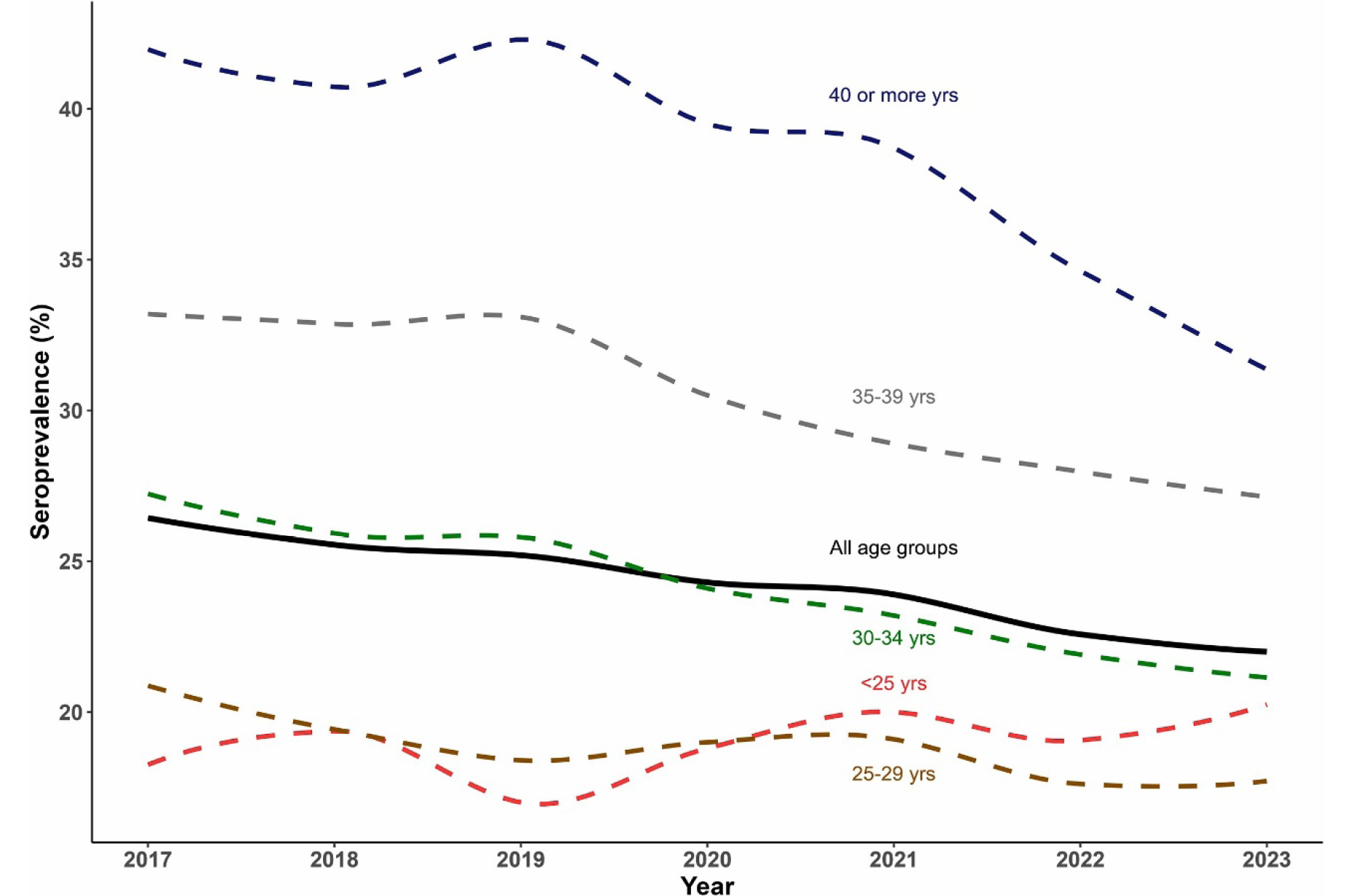
In the multivariable analysis of this study, seroprevalence was higher among pregnant women born in the WHO regions of Africa (39.9%), the Eastern Mediterranean (33.2%), and European regions (24.9%; excluding France) than among those born in France (20.6%). During the study period, 69 infections acquired during pregnancy were identified, corresponding to a mean annual incidence of 1.3 cases per 1,000 pregnancies at risk. The annual incidence of seroconversion remained stable, with no significant temporal trend. Maternal infections led to congenital toxoplasmosis in eight cases, resulting in one foetal death, and in the detection at birth of intra-cranial calcifications in one of the seven live births.
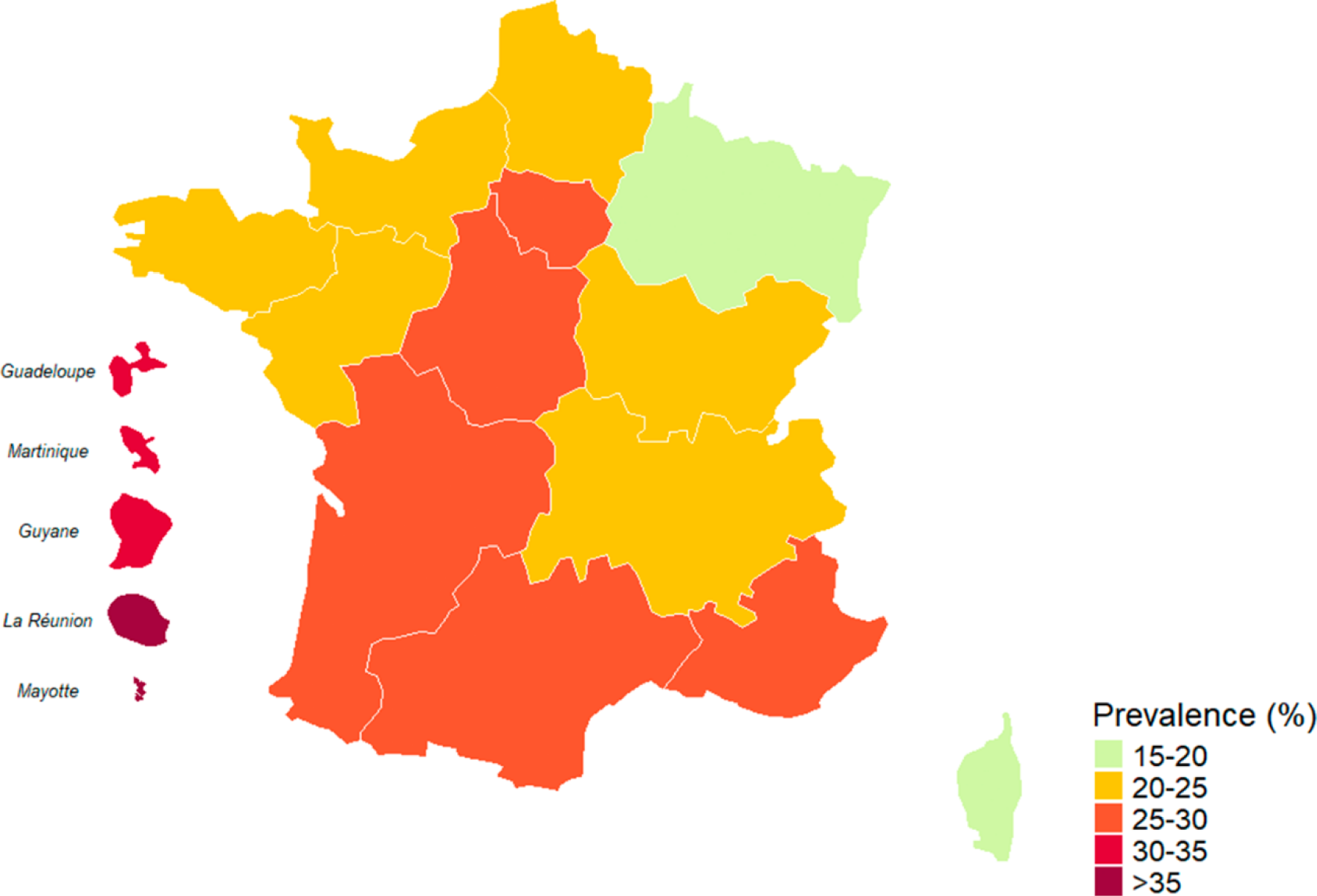
This decline in seroprevalence was consistent with that observed in the most recent French National Perinatal Surveys (5, 6). However, this reduction was not accompanied by a parallel decline in the incidence of maternal infection, and substantial differences according to the women’s region of birth persisted (6). Additionally, marked geographical differences in seroprevalence were observed across French regions (Figure 2).
This decreasing trend may be related to changes in dietary habits and hygiene practices and to the increasing use of intensive livestock production systems, including indoor housing, controlled feed and water supplies, and measures to reduce animals’ exposure to cats, rodents, and contaminated soil. The decline in beef and sheep meat consumption during this period (16), traditionally associated with a higher risk of transmission, may also have contributed to reducing exposure. Although the domestic cat population has increased in France over recent decades (17), the growing proportion of cats kept exclusively indoors and fed commercial diets may have reduced their contribution to environmental contamination.
Challenges and future perspectives
These findings have important epidemiological implications. A reduction in cumulative exposure does not necessarily lead to a proportional decrease in the risk of acquiring infection during pregnancy. This phenomenon may be partly explained by the increasing proportion of susceptible women, which offsets the reduction in environmental contamination and leaves a substantial number of pregnant women at risk of primary infection. Furthermore, exposure may become increasingly concentrated in specific population groups who are not adequately reached by prevention messages or who continue to engage in risky practices related to the consumption of contaminated food, contact with potentially contaminated soil, or exposure to the faeces of infected felids.
From a public health perspective, these findings suggest that educational interventions and preventive recommendations remain necessary, even in settings where seroprevalence has declined to relatively low levels. Owing to their broad population coverage and the systematic collection of data, prenatal screening programmes constitute a valuable source of epidemiological information. These programmes make it possible to identify local risk factors, examine the influence of demographic, cultural, and environmental variables, and update knowledge of the determinants of infection across different populations. Data generated through screening are also essential for evaluating the effectiveness and cost-effectiveness of prevention strategies. Their value increases when information is collected using standardised, high-quality protocols, enabling comparisons across regions and over time and generating robust evidence to inform public health decisions.
Nevertheless, declining seroprevalence poses new challenges for prenatal screening programmes. These include adapting preventive strategies to low-prevalence settings (for example, by prioritising the identification of higher-risk populations and the development of more cost-effective diagnostic tests (18)) and periodically reassessing the cost–benefit balance of universal screening. The growing number of seronegative pregnant women entails a greater volume of serological testing during pregnancy, making the development of efficient and economically sustainable diagnostic strategies particularly important.
Several studies have assessed the cost–benefit balance of prenatal toxoplasmosis screening programmes, showing that systematic prenatal screening can be a cost-effective strategy. In the United States, Stillwaggon et al. (19), compared a programme of monthly serological screening during pregnancy, like the French programme, with no systematic screening. Using an economic decision model, they concluded that universal screening yielded savings of approximately US$620 per newborn and was cost-effective when the incidence of congenital toxoplasmosis exceeded 1 case per 10,000 live births. Another decision-analytic modelling study concluded that systematic prenatal screening with monthly follow-up of seronegative pregnant women not only reduced the clinical burden of congenital toxoplasmosis but also generated societal savings of approximately €212 per birth compared with no screening (20).
According to this model, the French screening programme would have generated estimated savings of €148 million in 2020, further supporting systematic prenatal screening in settings with a similar epidemiological profile. Similarly, using data from the Austrian National Toxoplasmosis Registry up to 2013, Prusa et al. (21), showed that Austria’s prenatal screening programme generated substantial economic savings by reducing the number of severe cases of congenital toxoplasmosis. Nevertheless, these analyses and economic models should be interpreted cautiously, as the cost-effectiveness of prenatal screening programmes depends on dynamic parameters, including seroprevalence, the incidence of maternal infection and congenital toxoplasmosis, diagnostic test performance, and healthcare costs. These evaluations should therefore be updated periodically to reflect changing epidemiological patterns and healthcare systems.
Beyond its potential cost-effectiveness, the French programme systematically identifies susceptible women and follows them throughout pregnancy, making it a valuable epidemiological surveillance tool. The resulting data make it possible to monitor maternal infections and cases of congenital toxoplasmosis, assess temporal trends in the disease, and explore demographic and regional differences in exposure. This type of information would be difficult to obtain from isolated cross-sectional studies.
However, the use of these data at the international level remains limited by the lack of standardisation across countries. European systems differ considerably in their prenatal screening policies, case definitions, diagnostic and treatment protocols, and surveillance and reporting systems (13). Consequently, international comparisons remain challenging, and the evidence available to inform public health decisions remains fragmented.
In this context, implementing pilot programmes for prenatal screening and serological monitoring in selected areas could help identify maternal infections and cases of congenital toxoplasmosis more comprehensively, establish long-term prospective cohorts, and provide more accurate estimates of incidence and disease burden. Such programmes could also facilitate the identification of the main risk factors and transmission routes in each epidemiological setting and enable assessment of the effectiveness and cost-effectiveness of preventive interventions. Maximising the value of these initiatives would require greater harmonisation of surveillance, diagnostic, and follow-up protocols. The adoption of standardised methods for estimating seroprevalence and the incidence of maternal infection and congenital toxoplasmosis, together with common criteria for case diagnosis, treatment, and follow-up, would facilitate multicentre studies, improve international comparability, and provide a stronger evidence base for guiding prevention policies.