Introduction
The outbreak of Andes hantavirus (ANDV) linked to a transatlantic cruise ship detected in May 2026 constituted an unusual scenario of national and international public health interest.
Although cases were reported in several countries, including Spain, the risk to the Spanish general population was considered very low due to the virus´s limited transmission capacity and the rapid implementation of public health measures.
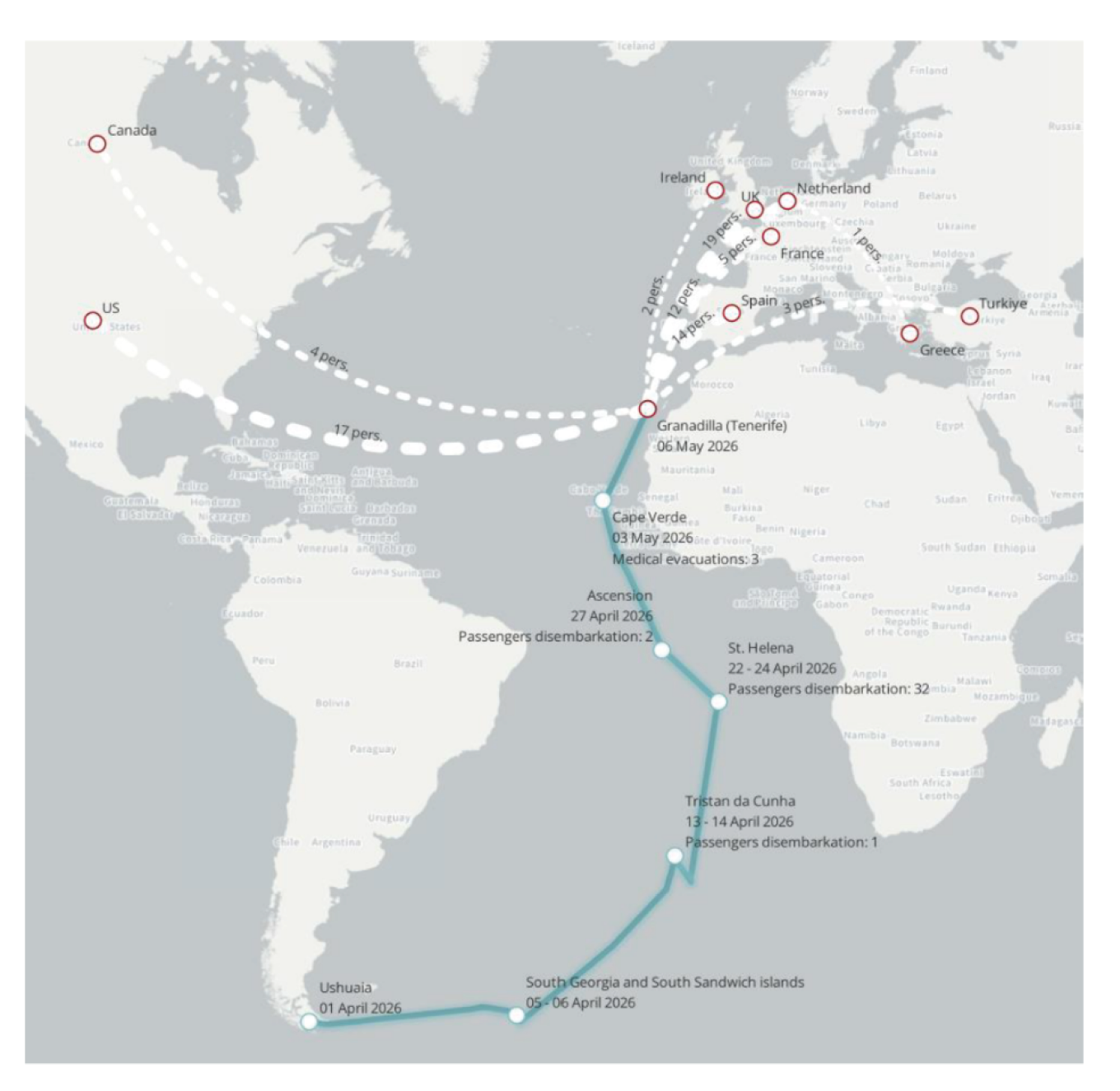
On 2 May 2026, the National International Health Regulations (IHR) Focal Point for the United Kingdom of Great Britain and Northern Ireland notified the World Health Organization (WHO) of an outbreak of severe acute respiratory illness aboard a transatlantic cruise ship that had departed from Ushuaia (Argentina) on 1 April on route to Cape Verde, making stops at several islands in the South Atlantic. The Dutch-flagged vessel carried passengers and crew from 23 countries, including 14 Spain residents. The first affected individual, a 70-year-old passenger, developed gastrointestinal symptoms and died on 11 April. Two weeks later, on the island of Santa Helena, 32 people disembarked, among them the deceased widow, who travelled on a commercial flight to Johannesburg to catch another flight to Amsterdam. However, before take-off she had to be transferred to the hospital, where she died on 26 April. A third passenger was medically evacuated in critical condition from Ascension Island to Johannesburg and became the first laboratory-confirmed case(1). A fourth passenger who disembarked in Saint Helena (a UK Overseas Territory) and was admitted to a hospital in Switzerland a few days later became the first case in which ANDV infection was confirmed. The ship arrived in Cape Verde on 3 May, from where two additional cases were evacuated. On board remained the body of an 80‑year‑old passenger who had died on 2 May and was later also confirmed as a case. An eighth case was reported in a passenger who had disembarked in Tristan da Cunha (a UK Overseas Territory) on 13 April.
Since 5 May, WHO and European Centre for Disease Prevention and Control (ECDC) epidemiologists, together with infectious‑disease specialists from the Netherlands, implemented measures on board to reduce the likelihood of transmission among passengers and crew.
Within the framework of the International Health Regulations and Regulation (EU) 2022/2371 of the European Parliament and of the Council of 23 November 2022 on serious cross‑border health threats, a range of coordinated international response measures was established from the outset. These included continuous collaboration and information exchange between WHO, ECDC/the European Commission, and the countries involved. An epidemiological investigation was also launched to identify the possible source of exposure, guide additional measures prior to the evacuation or disembarkation of those on board, and determine the origin of the outbreak. In parallel, microbiological studies were initiated to assess viral characteristics potentially associated with increased pathogenicity or transmissibility. In addition, on 7 May, Spain activated the European Civil Protection Mechanism to evacuate passengers and part of the crew in the port of Tenerife (Spain) to various destinations, mostly their countries of origin. The operation took place between 10 and 11 May and was coordinated by Spanish authorities, international institutions (WHO, ECDC), and the affected countries (Figure 1). Subsequently the ship departed for the Netherlands on 11 May and arrived in Rotterdam on 18 May for a full inspection and disinfection procedures.
Source: ECDC
Globally, contact tracing linked to the outbreak identified more than 440 contacts across at least 30 countries and territories, who were placed under quarantine or follow‑up according to their assessed level of risk(2).
At the national level, the Ministry of Health, in coordination with the Autonomous Communities (CCAA), developed protocols for clinical management and individual protective measures to prevent viral transmission. These protocols were reviewed and updated by the Technical Committee of the Early Warning and Rapid Response System (SIAPR) and approved by the Public Health Commission. On 8 May, a protocol was published outlining healthcare and public‑health actions for residents of Spain who were to disembark, as well as for potential contacts and probable or confirmed cases. A revised version was issued on 13 May, incorporating recommendations from the European Reference Laboratory (EURL‑PH‑ERZV) regarding the handling and transport of clinical samples. On 22 May, an updated version was released; it included conditions for visits and access to common areas for individuals in hospital quarantine, as well as requirements for home quarantine. Annex 2, detailing preventive measures for hospital staff, was also amended. Finally, on 3 June, a further update established the criteria for hospital discharge of confirmed cases and the follow‑up procedures to be applied thereafter(3).
In the days following the evacuation, five cases were detected worldwide among high‑risk contacts who were under quarantine: two in Spain and one each in France, Canada, and the Netherlands. Since the beginning of the outbreak, a total of 13 cases were reported (12 laboratory‑confirmed and 1 probable, considered the index case), with symptom onset dates ranging from 3 April to 31 May. Of the 13 cases, 3 died and 2 developed severe disease (Figure 2).
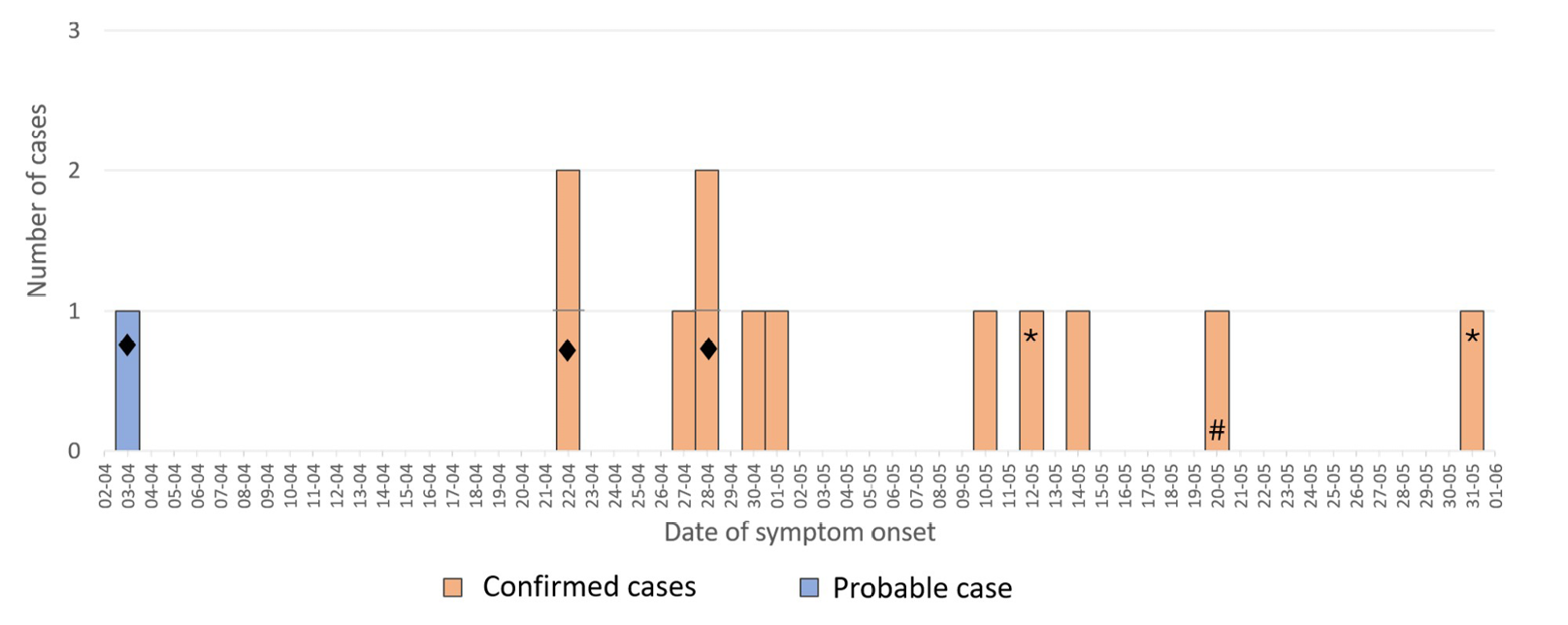
* Confirmed cases detected in Spain; # asymptomatic confirmed cases: confirmation data. ♦ Deaths. Source: Author’s elaboration based on data provided by WHO, Early Warning and Response System (EWRS) of the European Union, and the Ministry of Health of Spain.
In Spain, 16 individuals were classified as high‑risk contacts (14 passengers and crew members from the ship, and two linked to the Johannesburg–Amsterdam flight). They were required to undergo a 42‑day period of monitoring and quarantine from the date of last exposure. Among the ship‑related contacts, 2 individuals became confirmed cases during follow‑up, presenting positive blood PCR results and symptoms in the subsequent days. The remaining contacts completed an initial 28‑day hospital quarantine, followed by 14 days at home, remaining asymptomatic with negative test results throughout.
The most likely hypothesis regarding the origin of the outbreak is that some passengers became infected through environmental exposure to ANDV during their prior stay in endemic areas of Argentina. From these initial cases, secondary transmission to other passengers would have occurred during the voyage. This interpretation is supported by genetic analyses showing a high degree of similarity among viral sequences from confirmed cases—virtually identical, with very few mutations between them(4). These findings are consistent with previous Andes hantavirus outbreaks, such as the 2018 Epuyén outbreak in Argentina(5).
Andes Hantavirus Disease
ANDV, endemic to Argentina and Chile(6), can cause severe hantavirus cardiopulmonary syndrome (HCPS), which carries a high fatality rate, and is the only hantavirus for which consistent person‑to‑person transmission has been demonstrated(6). Human infection occurs primarily through inhalation of contaminated aerosols in rural areas inhabited by sigmodontine rodents, the natural reservoir. After a prolonged incubation period of 7 to 45 days(2,5,6), the disease may progress rapidly from nonspecific symptoms to respiratory failure and shock in some cases. No specific treatments or vaccines exist, making early detection and intensive supportive care essential.
ANDV infections are rare globally. In 2025, eight countries in the Americas reported 229 HCPS cases and 59 deaths, with no cases specifically attributed to this virus(7). Transmission remains predominantly zoonotic, linked to rodent exposure.
Person‑to‑person transmission is exceptional and has been documented only in isolated outbreaks in Argentina and Chile(5, 6). These outbreaks typically involve short transmission chains with few cases, although longer chains have been recorded, such as during the 2018–2019 Epuyén outbreak. In that event, spread was facilitated by social gatherings involving numerous close interpersonal contacts, rather than by any apparent increase in viral transmissibility(5).
Risk Assessment for Spain
During the management of the alert related to the Andes hantavirus outbreak linked to a transatlantic cruise, the Coordination Centre for Health Alerts and Emergencies conducted, with the support of numerous experts and institutions, a rapid risk assessment of ANDV transmission in Spain(8). Its conclusions are summarised below.
To date, no autochthonous human cases of hantavirus infection have been detected in Spain. Although hantaviruses have been identified in several wild mammal species, none has shown pathogenicity for humans(9). Rodents of the Sigmodontinae and Neotominae subfamilies are found exclusively in the Americas. Therefore, the risk of ANDV transmission through rodents or their excreta in Spain is extremely low, both because the reservoir species are absent from Spanish territory and because the virus has not been detected in any local small‑mammal species(10). Based on available evidence, the risk of transmission of other pathogenic hantaviruses in Spain is also considered very low, given the limited evidence of their presence in local wildlife and the absence of historical detections in humans.
During the outbreak, the only potential route of transmission in Spain would have been close contact with infected individuals during their transmissible period or occupational exposure to clinical samples. All cases and contacts were monitored according to established protocols, and involved professionals applied the recommended prevention and control measures. Consequently, the risk of secondary transmission in Spain was considered very low.
Finally, there is no increased risk for typical tourists or business travellers visiting major cities in endemic countries. Risk is primarily associated with specific activities such as ecotourism in rural areas, agricultural or forestry work, or occupations involving environmental exposure where contact with the long‑tailed pygmy rice rat (Oligoryzomys longicaudatus), the natural reservoir, may occur. The most common route of infection is inhalation of aerosols from the urine, faeces, or saliva of infected rodents, typically when cleaning unventilated enclosed spaces or camping in endemic areas. In any case, the overall risk is considered very low, as the disease is rare.
Conclusions
This event highlights the importance of maintaining surveillance systems capable of early detection of imported emerging diseases and coordinating international responses to events with potential for cross‑border transmission. It also underscores the need for specific protocols for rare pathogens with demonstrated person‑to‑person transmissibility.
Based on available evidence, the risk of local transmission of pathogenic hantaviruses—including Andes virus—in Spain is considered very low, given the limited evidence of their presence in local small mammals and the absence of historical human cases. For travellers to endemic areas, risk is concentrated in rural or natural settings where exposure to infected rodent excreta may occur. Nevertheless, the disease is rare, and risk can be significantly reduced through appropriate preventive measures.